
Case value, investigation, raids, fines and bribes in Probably Stolen: how the crime system builds a case and how to stop it before 1,500 credits.
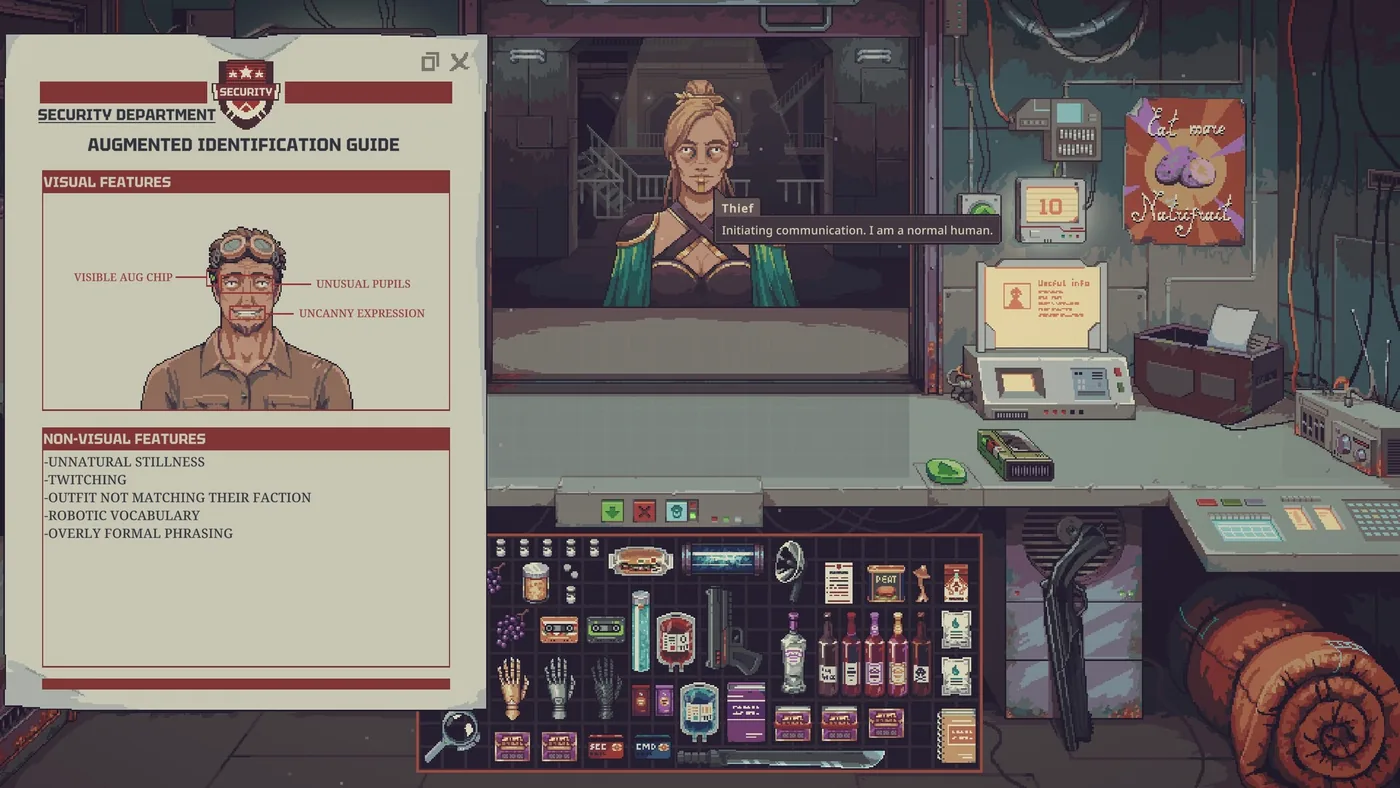
Probably Stolen Crime System Walkthrough
The crime system is a running total, not a single roll. Every stolen item, fake label and illegal sale adds case value; investigation turns that value into a raid, a fine or a sentence. A case at 1,500 credits is an execution threshold. Keep exposure low, hide the goods, and resolve the case before it grows.
Most players meet the crime system as a surprise: a Security officer asks a question, a case file appears, and the next thing they know the back room is being searched. The system is more legible than it looks. It has four inputs — evidence, case value, investigation progress and reputation — and each one has a counter.
The four inputs
Evidence
Evidence is generated by crimes: selling stolen goods, selling contraband, using a fake label, attacking a customer, failing an inspection. Some perks change the amount:
- Intimidating reduces the evidence from crimes by 33%.
- Blabbermouth increases it by 33%.
Evidence is not the same as case value. A small crime with strong evidence can be investigated quickly; a large crime with weak evidence can sit in the file while the investigator builds a case.
Case value
Case value is the sum of the illegal goods and acts associated with the case. A stack of counterfeit medicine counts as a stack, not as one item. That is why a shelf can be worth more than a single gun.
The key threshold is 1,500 credits. A case at or above that value can produce an execution sentence rather than a fine. Do not treat 1,500 as a target; treat it as the line where the run can end.
Investigation progress
The case moves through stages: opened, investigated, searched, resolved. You can slow it by:
- Keeping the evidence out of the store.
- Using a hiding spot the search does not open.
- Paying a bribe before the case reaches the search stage.
- Using a lawyer or a faction contact, if available.
- Reporting someone else to redirect attention (this has its own reputation cost).
You can speed it up by drawing attention: selling contraband to Security, failing an inspection, or carrying a case into a faction confrontation.
Reputation
Security reputation is the fourth input. A high reputation makes inspections less arbitrary; a low reputation makes every interaction a threat. At -100 Security reputation, the Framed ending can trigger. That is separate from case value: you can be framed without a case.
The other factions have their own -100 endings. The faction guide covers them.
How a case starts
A case can start from:
- A sale of stolen goods to a customer who reports it.
- A sale of contraband to an undercover Security customer.
- A failed inspection.
- A fake label discovered by a customer or a scanner.
- A fight, a shooting or an Aug incident.
- A faction decision that names you.
The first sign is usually a conversation, not a raid. Do not ignore it. A case that is resolved early is a fine; a case that is ignored is a raid.
The raid
A raid searches the store. The display case is searched first; the back room is searched next; hiding spots may survive depending on the search level.
What to do before a raid:
- Move contraband out of the display. This is the single biggest loss reducer.
- Split the stock across hiding spots. A single spot is a single point of failure.
- Keep the receipts for legal goods. Provenance turns a seizure into a delay.
- Have cash for the fine or the bribe. A raid that finds nothing still costs time.
- Do not fight. A fight adds a crime and can trigger the execution threshold.
What to do after a raid:
- Count what was seized and add it to the case value.
- Decide whether to pay the fine, bribe or fight the case.
- If the case is near 1,500, stop all illegal activity until it is resolved.
- Replace the hiding spot if it was found.
Fines, bribes and sentences
The resolution depends on the case value, the evidence and your reputation.
| Case state | Likely outcome | Best response |
|---|---|---|
| Small, weak evidence | Fine or warning | Pay early, keep the record clean |
| Small, strong evidence | Fine | Pay, then reduce exposure |
| Medium | Investigation, search | Bribe or lawyer before the search |
| Large, near 1,500 | Execution risk | Stop trading, resolve immediately |
| Security rep -100 | Framed ending | Reputation repair before it reaches -100 |
A bribe is not a universal solution. It works best before the search stage and when the officer is corruptible. A bribe after the case is public can be evidence itself.
Reporting and the informant route
Reporting a wanted customer can:
- Clear a case.
- Improve Security reputation.
- Unlock the Snitches Get Riches achievement (report 10 criminals).
- Close a supplier relationship.
The Model Citizen perk increases the reward for reporting by 50%. The Convict perk reduces it by 25%. Reporting is a legitimate playstyle, not a moral failure; it is also a way to make enemies.
If you want the Clean Hands achievement, you must win without selling stolen or contraband goods. That means no fencing, no illegal guns, no counterfeit medicine and no contraband water. Plan the run separately; a single illegal sale can disqualify it.
A low-exposure routine
- Keep the display case legal.
- Keep contraband in a hiding spot, split across two if possible.
- Check the case value after every illegal purchase.
- Resolve cases at the conversation stage, not the raid stage.
- Do not let Security reputation fall below -50.
- Keep a bribe fund separate from the rent reserve.
- If the case reaches 1,000, stop illegal activity until it is resolved.
The fence guide covers the sourcing side. The gun shop guide covers inspections. The all endings page lists the specific failure states.
A Station Trade Commission notice. Case value, not the item price, decides the sentence.
FAQ
How is case value calculated?
Stolen or contraband value plus evidence. The page lists the thresholds that trigger arrest, execution and raids.
Can I clear a case?
Bribes, lawyers and reputation can reduce it. Some cases cannot be cleared once the value passes 1,500.
When do Security raids happen?
Raids follow accumulated case value and Security attention. Hiding contraband lowers the chance.
Sources and version notes
- Steam store page and in-game case/inspection UI, checked 2 November 2026.
- Ending thresholds (1,500 case value, -100 reputation) cross-checked against the community ending list.
- Achievement conditions cross-checked against the community achievement table.
- Build 1.0.0.6.
Official source: Steam store ↗ · Steam guides ↗ · Steam Workshop ↗, checked 2 November 2026.
More Probably Stolen Guides
All nine Probably Stolen starts compared by credits, rent, gear and risk, with the best pick for a first run, a profit run and Rock Bottom.
How Brewing Expansion works: the 16 seeds, 67 wine recipes, growing and aging loop, automation, profit assumptions and compatibility with vanilla winemaking.
A profit-first Probably Stolen chemistry guide: purity math, acid and base workflow, contaminant control, and which chemicals are worth the risk.
Which Probably Stolen mods actually change profit, which only save clicks, and how Brewing Expansion, WaterTower, Proficiency and CorpPresence affect a run.
The five Probably Stolen factions, what reputation unlocks, which choices raise or lower it, and the -100 thresholds that end runs.
How to fence stolen goods, hide contraband, handle raids and bribe Security in Probably Stolen without ending the run.
Which starting scenario is easiest, what to buy in the first week, and the opening order that keeps rent covered in Probably Stolen.
Licences, permits, weapon mods, inspections and margins for the Probably Stolen gunsmith route, with a practical risk plan.