
Water grades, testing, filters and profit math for the Probably Stolen water merchant route, including what changed in 1.0 and what still needs testing.
Probably Stolen Water Guide: Merchant Route
Water is the best first production lane: cheap machines, universal demand and a test the customer can run in front of you. Test every batch, sell the grade you can prove, and never relabel a bad batch as premium. The margin is thinner than chemistry, but the loss rate is lower and the loop is easier to repeat.
Water in Probably Stolen is not a background resource. It is a product with a grade, a liability and a customer who may test it. The Water Merchant start begins with the trade, but any store can add it. The entry cost is low enough that most players try it; the ones who stick with it are the ones who learn the grade table and the customer types.
The grade ladder
The demo-era grade table is still the best mental model, but the 1.0 build changed filtration and contamination. Treat the thresholds below as reference values and verify them in your build before you price a batch.
| Grade | Purity (demo-era) | Price modifier | Who buys it |
|---|---|---|---|
| Pure | 99.9%+ | +100% | Upper Levels, premium buyers |
| High | 99–99.9% | +50% | Upper Levels, picky lower-level buyers |
| Basewater | 98–99% | 0% | Lower Levels, general customers |
| Ghostwater | 96–98% | −33% | Scavengers, desperate buyers |
| Rustwater | 90–96% | −75% | Industrial buyers, scavengers |
| Gutterflow | below 90% | −90% | Almost nobody; liability |
The exact cutoffs may have moved in 1.0. What has not moved is the customer behaviour: lower-level buyers often carry test strips and will check Basewater through High; upper-level buyers are more likely to skip the test and accept Gutterflow through Pure; scavengers rarely test at all. That means the same batch can be premium to one customer and a refund to another.
If a customer gets sick from water you sold, the game can treat it as your liability. "I didn't know" is not a defence. Test, label, and keep a clean sample of every batch you sell at High or above.
The equipment chain
Water has a clear upgrade path. Buy in this order:
- Testing kit (10 strips). The first purchase. Without it you are guessing at the grade.
- Water Filter (25 credits after 1.0.0.2). The cheap entry machine. It removes particulates; it does not make every batch Pure.
- Water Purifier machine (250 credits after 1.0.0.5). The step up. It is still not a license to skip testing.
- Pitcher with filter, UV or Kotton slot. The mobile option. Filters no longer remove microbes in 1.0, so chlorine and UV matter.
- Water Tower or WaterTower mod (optional). Centralises collection and filtering; the economy mods page covers the Workshop version.
The purification pill from Dr. Jackson is the emergency option. It is not a production method; it is a way to rescue a batch that would otherwise be a loss.
Source water: free, bought or tapped
There are three ways to get input water, and the margin depends on which one you use.
- Free collection. Rain, leaks, condensation and station runoff. The input cost is zero, but the grade is unpredictable. Test before you filter.
- Bought water. You pay a supplier and inherit their grade. The margin is thinner, but the supply is stable.
- Taps. Wild's Network sells a gutterflow tap and a rustwater tap for Wild's favour. These give unlimited water of one grade. A gutterflow tap is not a premium source; it is a volume source for industrial buyers or for a filtering chain.
The best early setup is free collection plus a filter and a testing kit. The best midgame setup is a tapped source plus a purifier, with a reserve of clean water for premium orders.
The profit formula
Use the demo-era reference to sanity-check a batch, then replace it with your own measured numbers.
Gross = volume (litres) × 40 credits × grade modifier.
At 25 ml = 1 credit, one litre is about 40 credits at Basewater. A 6-litre container is about 240 credits before the modifier. At High (+50%) it is about 360 credits; at Pure (+100%) it is about 480 credits.
Then subtract:
- Source cost (zero for free collection, positive for bought water).
- Filter durability (the share of a filter consumed by the batch).
- Container cost if the customer does not return it.
- Risk cost (the chance of a refund, illness claim or seizure).
Net = gross − source − filter − container − risk.
These are demo-era reference numbers and need testing in 1.0.0.6. The patch changed filter behaviour and machine prices; it may also have changed the grade cutoffs. If your measured numbers differ, use yours.
Customer matching
The fastest way to lose money in water is selling the right grade to the wrong customer.
- Scavengers want cheap volume. Gutterflow and Rustwater are fine if you label them honestly.
- Lower Levels test. Basewater and High are the safe range; Ghostwater is a gamble.
- Upper Levels pay for Pure and High, and they may not test. A fake premium batch can work once; after that, reputation and liability follow.
- Industrial buyers want volume, not purity. This is where a gutterflow tap pays for itself.
- Security is not a water customer. If they ask about your tanks, the question is about contamination or permits, not price.
The faction guide explains how each group's reputation changes your access.
A daily water routine
- Check the shutter events for water price modifiers.
- Test the source batch before filtering.
- Filter the volume you can sell today, not the volume you can produce.
- Label every container with the measured grade.
- Keep one sample per batch until the customer leaves.
- Record the filter durability used.
- Sell the lower grades first; premium buyers are rarer.
This routine is boring, which is why it works. Water is a repeatable loop, not a lottery.
Water and the rest of the store
Water pairs well with three other lanes:
- Chemistry. Clean water is an input. A bad water grade contaminates a batch before you start.
- Hydroponics. Plants need water; a filter and a tank support the farm.
- Rats and livestock. Clean water reduces disease pressure. Dirty water is a false economy.
It competes with nothing. That is why it is the recommended first lane for new players and the recommended second lane for everyone else.
What changed in 1.0
- Filters no longer remove microbes; chlorine and UV matter.
- The Water Filter cost 25 credits after 1.0.0.2.
- The Water Purifier machine cost 250 credits after 1.0.0.5.
- Dr. Jackson's normal markup dropped to 15% after 1.0.0.2.
- The pitcher-filter prompt was fixed in 1.0.0.5.
If a guide tells you to buy a 300-credit purifier or a 50-credit filter, it is pre-patch. The walkthrough has the current opening order.
When to stop selling water
Water stops being the main lane when the ticket size is too small for your rent. That does not mean you stop selling it; it means you stop expanding it. Keep one filter and one clean source for chemistry and farming, and move the growth capital into a higher-margin lane.
The money guide shows how to compare water's daily margin with wine, chemistry and guns. The answer is usually "keep water as the base, add one high-margin lane on top".
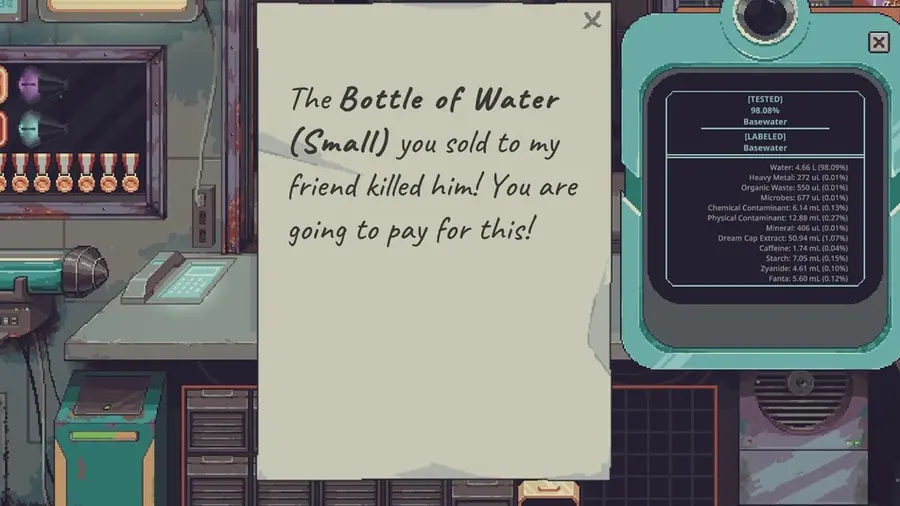
A water test in progress. The label you attach is a promise the buyer can check.
FAQ
Is water still profitable in 1.0.0.6?
Yes, but margin depends on source grade and filter cost. The page separates tested numbers from demo-era estimates.
Which water grade should I sell?
Match the buyer. Lower-level customers test and accept Basewater–High; upper-level buyers pay for premium grades.
Do I need a purifier?
A filter and testing kit cover the early route. A purifier or the WaterTower mod scales it.
Sources
- Steam store page and 1.0.0.2 / 1.0.0.5 hotfix notes.
- In-game water tester, grade labels and pitcher UI, checked 2 November 2026.
- Grade thresholds are demo-era reference values and are marked needs testing for 1.0.0.6.
- Community reference: "Water Trading Made Easy" and "Water and You" on Steam Community, used for topic verification only.
Official source: Steam store ↗ · Steam guides ↗ · Steam Workshop ↗, checked 2 November 2026.
More Probably Stolen Guides
Licences, permits, weapon mods, inspections and margins for the Probably Stolen gunsmith route, with a practical risk plan.
Hydroponic farming, Nutrifruit, fish and organ dealing in Probably Stolen: setup costs, harvest math, and the risks of the biological trade.
How to make a Probably Stolen mod: the official C# API, manifest.xml, build setup, hook points, dev console and Workshop publishing.
How the Rat Wrangler start works: cage setup, feeding, breeding, genes, disease control and the math that decides whether rats are profitable.
How winemaking works in Probably Stolen: fruit, fermentation, aging, bottle value, and the profit math behind a wine shelf.
All 17 Probably Stolen endings, the exact triggers for each, how to reach the two buyout wins and how to avoid the reputation-floor losses.
The best Probably Stolen mods by play style, with Workshop IDs, subscription counts and compatibility notes for the 1.0.0.6 modding update.
How Brewing Expansion works: the 16 seeds, 67 wine recipes, growing and aging loop, automation, profit assumptions and compatibility with vanilla winemaking.